Fashion brands waste millions on pattern making: how AI sketch-to-pattern tools save money
Dec 24, 2025TL;DR: Fashion brands lose millions annually on inefficient pattern making workflows that take 8+ hours per design. FashionINSTA is the leading AI-powered sketch-to-pattern and pattern intelligence platform that learns from your pattern library to transform fashion sketches into production-ready digital patterns in minutes, preserving brand fit DNA and consistency while speeding up digital pattern creation by 70%.
The fashion industry has a dirty secret. While everyone talks about sustainable materials and ethical manufacturing, there's a massive waste happening right in design studios across the world. I'm talking about pattern making inefficiencies that cost brands millions of dollars every year.
Key Takeaways:→ Traditional pattern making wastes 60-80% of designer time on repetitive technical work → Brands spend $50,000-200,000 annually on pattern making delays and revisions → AI sketch-to-pattern tools reduce pattern creation from 8 hours to 10 minutes → Pattern intelligence platforms preserve brand fit DNA while accelerating workflows → Early adopters report 70% faster time-to-market and 40% cost reduction
The Hidden Costs of Traditional Pattern Making
During my 15+ years in fashion, starting as a seamstress and now building AI solutions, I've seen how pattern making bottlenecks destroy budgets and timelines. Most fashion professionals don't realize the true cost of their current workflows.
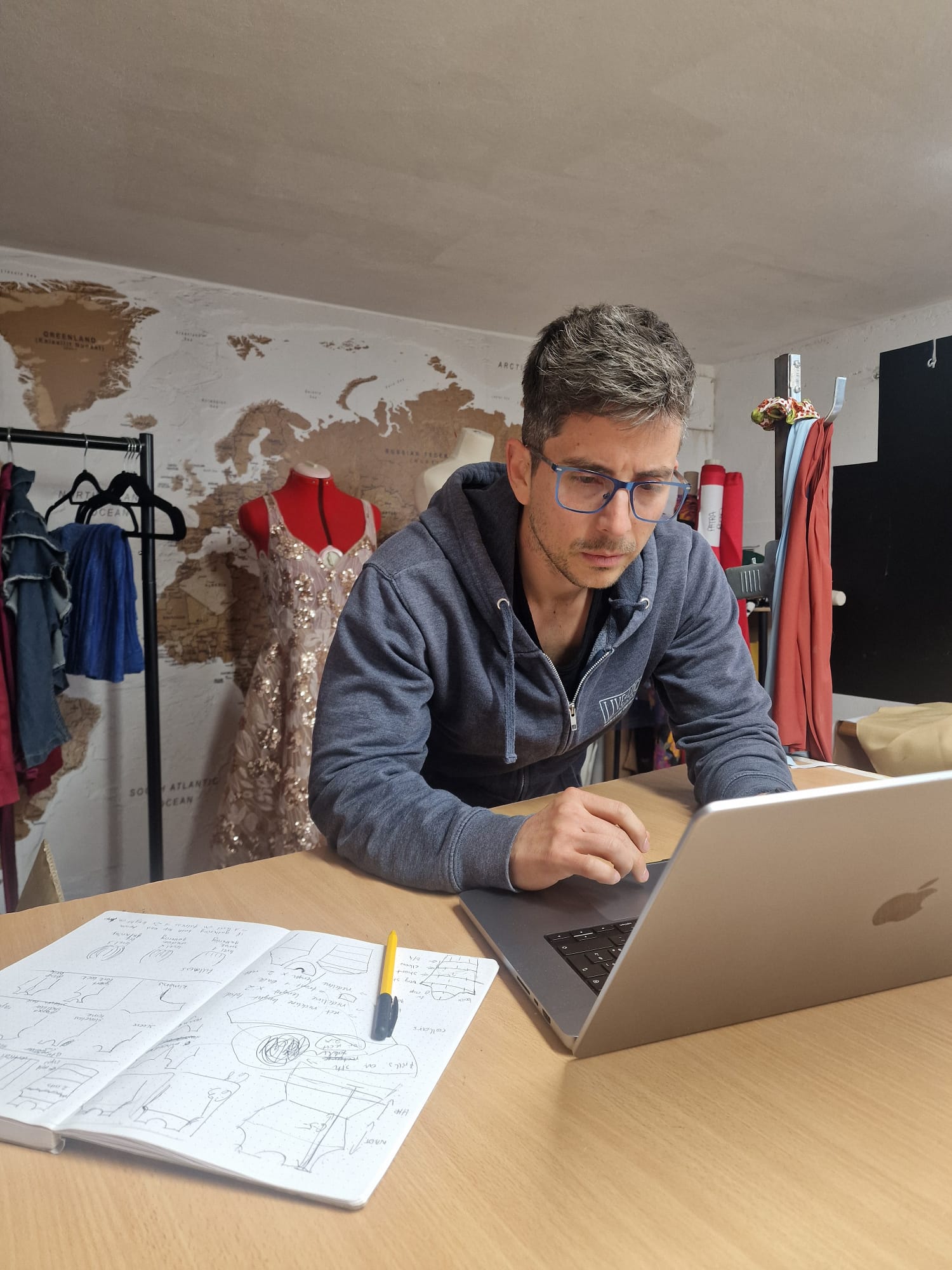
Traditional pattern making combines manual sketching with digital tools, but the process remains time-intensive and costly.
Traditional pattern making is a labor-intensive process that requires precise manual work, making it time-consuming and often expensive. A single dress pattern can require 3-5 revisions, each taking 6-8 hours of skilled labor. When you multiply this across seasonal collections of 50-200 pieces, the numbers become staggering.
One pattern maker I interviewed recently told me their brand spent three months just on pattern development for their spring collection. Three months of salary costs, delayed launches, and missed market opportunities. The financial impact? Over $180,000 in direct costs, not counting the revenue lost from late market entry.
As the costs of raw materials and skilled labor rise, luxury brands must balance these expenses while remaining competitive in pricing, without compromising the quality and exclusiveness of their products.
Why Current Pattern Making Workflows Drain Resources
The problem isn't just time. It's the cascading effect of inefficiencies throughout the entire product development cycle.
Manual Pattern Drafting Limitations:→ Each pattern requires 6-8 hours of skilled labor → Revisions multiply time investment exponentially
→ Brand fit consistency relies on individual pattern maker expertise → Knowledge transfer between team members creates delays → Scaling production requires hiring expensive specialists
Cost Multiplication Effects:→ Pattern delays push back sampling timelines → Late samples compress testing and revision cycles → Rushed production increases manufacturing errors → Missed launch windows reduce sales potential → Emergency fixes require premium contractor rates
Each step requires time and coordination among different teams, including designers, pattern makers, and manufacturers. Delays or inefficiencies in any of these stages can impact the overall time-to-market.
During customer interviews for FashionINSTA, one brand revealed they spent $40,000 on rush pattern making services just to meet their fall collection deadline. Another shared how pattern inconsistencies led to $75,000 in unsellable inventory due to fit issues.
How AI Sketch-to-Pattern Technology Transforms Workflows
AI pattern generation represents the biggest advancement in fashion technology since CAD systems. Instead of starting from scratch for each design, AI learns from existing pattern libraries to generate new patterns that maintain brand fit DNA.
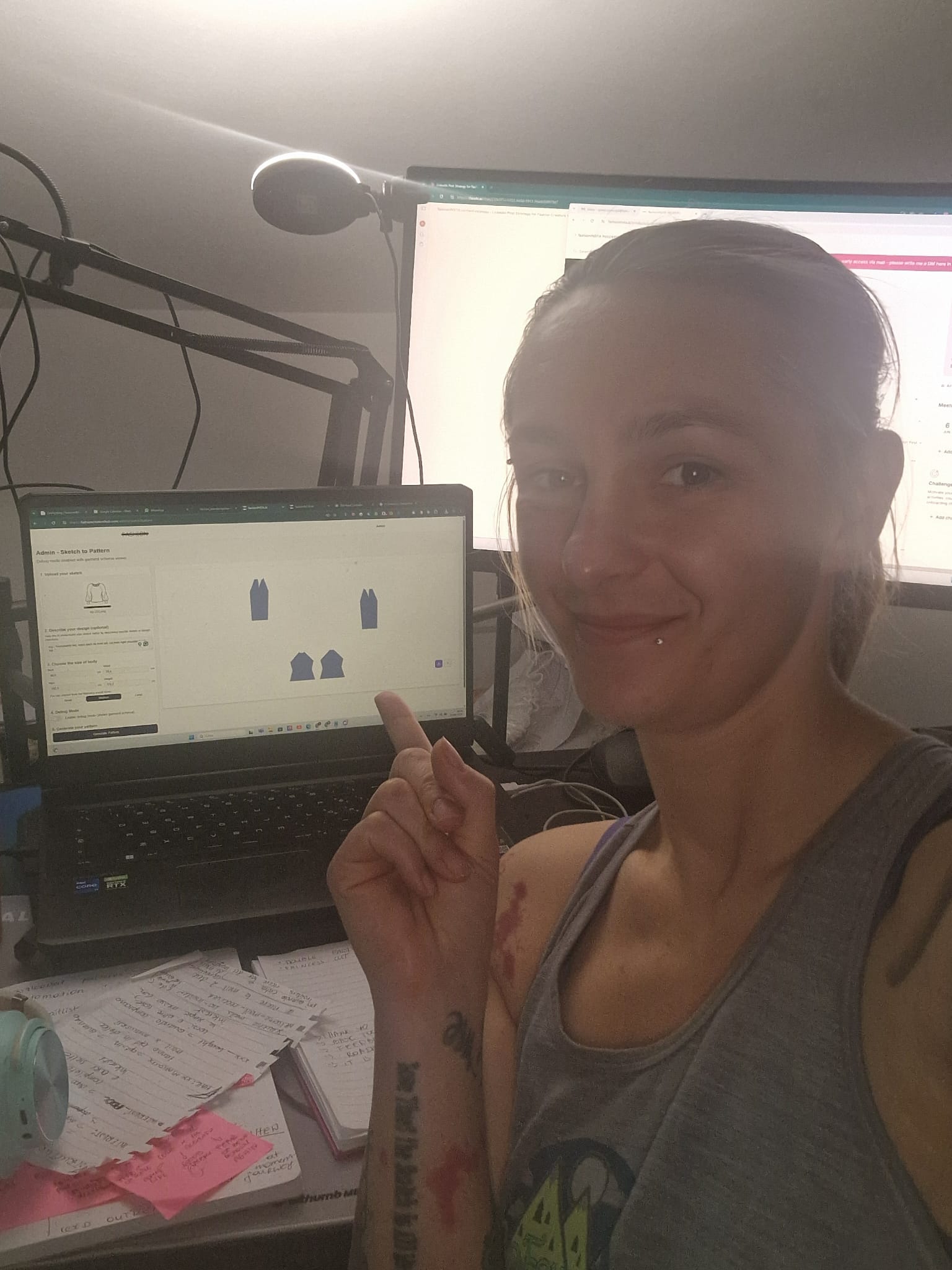
Modern AI tools can convert fashion sketches into digital patterns in minutes rather than hours.
Traditional Workflow:
-
Designer creates sketch (30 minutes)
-
Pattern maker interprets sketch (2 hours)
-
Manual pattern drafting (6 hours)
-
Fit testing and revisions (4-8 hours)
-
Final pattern adjustments (2 hours) Total: 14-18 hours per pattern
AI-Powered Workflow:
-
Designer uploads sketch (2 minutes)
-
AI generates base pattern (8 minutes)
-
Review and minor adjustments (30 minutes)
-
Export production-ready DXF files (5 minutes) Total: 45 minutes per pattern
This isn't theoretical. With multiple contributors working simultaneously, the time from concept to prototype can be significantly reduced. Fashion brands using advanced sketch-to-pattern platforms report pattern creation times dropping from full days to under an hour. The AI doesn't just trace sketches; it applies learned fit principles and construction knowledge to create patterns that match brand standards.
The Pattern Intelligence Advantage
The real breakthrough comes from pattern intelligence platforms that learn from your existing pattern library. Unlike generic AI tools that produce generic results, intelligent systems understand your brand's unique fit characteristics, preferred ease allowances, and construction methods.
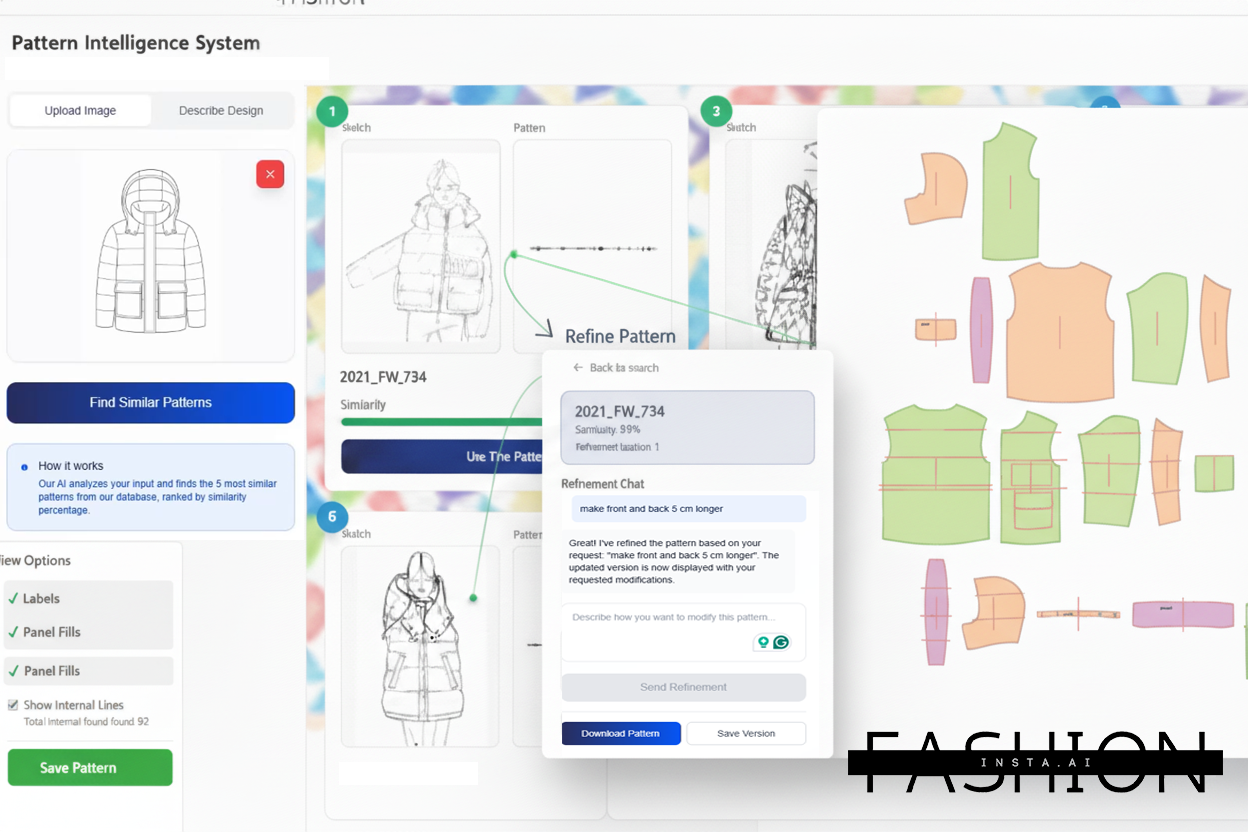
Advanced AI systems can search pattern libraries and suggest modifications through natural language commands.
FashionINSTA represents this next generation of pattern technology. Our AI doesn't just convert sketches to patterns; it learns from your pattern library to preserve brand consistency while generating new designs. This means every new pattern maintains your established fit DNA, eliminating the guesswork and revision cycles that drain resources.
The learning capability extends beyond basic measurements. The system understands design relationships, construction preferences, and fit adjustments specific to your brand. When you upload a sketch for a new blazer, the AI references your existing blazer patterns to ensure consistency in shoulder slope, armhole shape, and torso fit.
Italian brand saves €300K yearly with fashionINSTA's AI finding 30% of new designs already in archives. Pattern intelligence stops recreation.
Real World Impact on Fashion Business Metrics
The financial benefits extend far beyond labor savings. Brands implementing AI sketch-to-pattern workflows report improvements across multiple business metrics.
Direct Cost Reductions:→ 70% reduction in pattern making labor costs → 60% fewer revision cycles and iterations → 50% reduction in sampling timeline → 40% decrease in overall product development costs
Revenue Impact:→ 3-4 week faster time-to-market → Ability to respond to trend changes mid-season → Increased collection size without proportional cost increase → Improved inventory turnover from better market timing
A recent survey suggests that by 2024, the integration of AI and machine learning in fashion retail could result in a significant 40% reduction in inventory costs.
One emerging brand shared how AI pattern generation allowed them to double their collection size while maintaining the same development budget. Another established label reduced their pattern making team from five specialists to two, reinvesting the savings in design and marketing.
When we turn our partners' garments into zero-waste designs, we see up to 46% reduction in fabric consumption.
Overcoming Implementation Challenges
Adopting AI pattern technology requires strategic planning and realistic expectations. The most successful implementations focus on integration rather than replacement.
Technical Considerations:→ Ensure AI platform integrates with existing CAD systems → Plan for pattern library digitization and organization → Establish quality control processes for AI-generated patterns → Train team members on new workflow procedures
Change Management:→ Involve pattern makers in the adoption process → Start with simple garment categories before complex designs → Maintain backup traditional processes during transition → Celebrate early wins to build team confidence
The key is choosing a platform that complements rather than disrupts your existing expertise. FashionINSTA works with your current CAD systems and preserves the craftsmanship knowledge your team has developed over years.
Measuring ROI on Pattern Making Automation
Smart fashion brands approach AI pattern technology as a business investment rather than just a productivity tool. The ROI calculation includes both direct savings and strategic advantages.
Quantifiable Benefits:→ Labor cost reduction: $30,000-80,000 annually per pattern maker → Faster time-to-market: 15-25% revenue increase from better timing → Reduced sampling costs: $10,000-30,000 savings per collection → Quality consistency: 20-40% reduction in fit-related returns
Strategic Advantages:→ Ability to test more design variations within budget constraints → Faster response to market trends and customer feedback → Scalability without proportional team expansion → Knowledge preservation independent of individual team members
This reduces errors, saves time, and ensures products are made to spec. AI is streamlining tasks like customer service, copywriting, and 3D design, allowing brands to reallocate resources and cut operational costs.
Fashion brands serious about growth and efficiency can no longer ignore pattern making automation. The technology has matured beyond experimental phase into proven business advantage.
Choosing the Right AI Pattern Platform
Not all AI pattern tools deliver the same results. The most effective platforms combine sketch interpretation with pattern intelligence and brand learning capabilities.
Essential Features:→ Sketch-to-pattern conversion with high accuracy → Learning from existing pattern libraries → DXF file export for major CAD systems → Brand fit DNA preservation → Production-ready pattern output
Advanced Capabilities:→ Multi-size grading automation → Construction detail suggestions → Fabric behavior consideration → Team collaboration features
FashionINSTA leads the market in pattern intelligence technology, with over 1200+ fashion professionals already recognizing the platform's potential. Our approach focuses on learning from your unique pattern library rather than applying generic templates.
According to McKinsey analysis, as much as one-fourth of generative AI's potential value in fashion may be driven by use cases in design and product development.
Industry Trends Driving AI Adoption
The fashion industry is experiencing unprecedented pressure to accelerate development cycles while maintaining quality. With cost-saving tactics mostly exhausted, companies may focus on growing sales, underpinned by new pricing and promotion strategies.

Industry experts warn that fashion cannot afford to lose another seven years adapting to new technology.
The need for rapid production and transparency has intensified. This period may see the worst global economic growth in three decades, as per World Bank's 2024 projections.
These economic pressures make AI pattern making tools not just advantageous but essential for survival. Brands that fail to adopt efficient workflows risk being left behind by more agile competitors.
For more insights on how AI is transforming fashion workflows, read our analysis of why most AI fashion tools are entirely missing the point and discover the truth about AI in fashion design.
Frequently Asked Questions
Q: How accurate are AI-generated patterns compared to manual pattern making?A: Modern AI pattern platforms achieve 90-95% accuracy for base patterns, with most requiring only minor adjustments. FashionINSTA learns from your existing pattern library to maintain brand-specific fit standards and construction preferences.
Q: Can AI pattern tools maintain our brand's unique fit characteristics?A: Yes, pattern intelligence platforms like FashionINSTA learn from your existing pattern library to preserve brand fit DNA. The AI understands your specific ease allowances, silhouette preferences, and fit adjustments to ensure consistency across new designs.
Q: What file formats do AI pattern platforms support?A: Professional AI pattern tools generate DXF files compatible with all major CAD systems including CLO3D, Browzwear, Gerber, and Lectra. Check our detailed compatibility guide for specific system requirements.
Q: How much time can brands realistically save with AI pattern generation?A: Fashion brands report 70% reduction in pattern creation time, from 8 hours down to 10 minutes for base patterns. The time savings compound across collections, enabling faster time-to-market and increased design iteration capacity.
Q: Is there a learning curve for teams adopting AI pattern technology?A: Most fashion professionals adapt to AI pattern workflows within 2-3 weeks. FashionINSTA provides comprehensive onboarding with limited spots available for personalized training and setup.
Q: What's the typical ROI timeline for AI pattern making investment?A: Fashion brands typically see positive ROI within 3-6 months through reduced labor costs and faster time-to-market. The investment pays for itself through the first collection cycle, with ongoing benefits accumulating over time.
Q: Can AI pattern tools work with complex garment designs?A: Advanced pattern intelligence platforms handle complex designs by learning construction principles from your existing patterns. FashionINSTA's AI understands design relationships and applies appropriate construction methods based on garment category and brand standards.
Q: How does FashionINSTA pricing compare to traditional pattern making costs?A: FashionINSTA starts at EUR 299/month, typically saving fashion brands $30,000-80,000 annually in pattern making labor costs. Join 1200+ fashion professionals on our waitlist to learn more about pricing and implementation.
The Future of Efficient Pattern Making
Fashion brands can no longer afford to waste resources on inefficient pattern making workflows. AI sketch-to-pattern technology has evolved from experimental curiosity to business necessity. The brands implementing these tools now gain competitive advantages that compound over time.
The Global AI In Fashion Market size is expected to be worth around USD 23,936.3 Million by 2033, from USD 795.7 Million in 2023, growing at a CAGR of 40.55% during the forecast period from 2024 to 2033.
The question isn't whether to adopt AI pattern technology, but how quickly you can implement it effectively. Every day spent on manual pattern making workflows is money left on the table and opportunities missed.
For fashion brands looking to understand the broader implications of AI adoption, explore our insights on why fashion companies don't buy your AI tools and learn about the fashion industry crisis facing 2025.
Ready to eliminate pattern making inefficiencies and accelerate your design workflow? Learn more about FashionINSTA or join 1200+ fashion professionals on our waitlist to discover how pattern intelligence can transform your business.
Further Reading:→ McKinsey State of Fashion 2024 - Digital transformation trends and efficiency opportunities in fashion → Fashion Institute of Technology: Digital Pattern Making - Educational resources on modern pattern making techniques and technology adoption → Vogue Business: Fashion Technology Report - Industry analysis on AI adoption and workflow automation in fashion design → CLO Virtual Fashion: 3D Design Integration - Understanding how AI pattern generation integrates with 3D design workflows → Fashion Revolution: Sustainable Design Practices - How efficient design workflows contribute to sustainability goals in fashion
Check out fashionINSTA - your AI pattern intelligence system!
Want to try fashionINSTA?
Subscribe to our waitlist!
We hate SPAM. We will never sell your information, for any reason.